
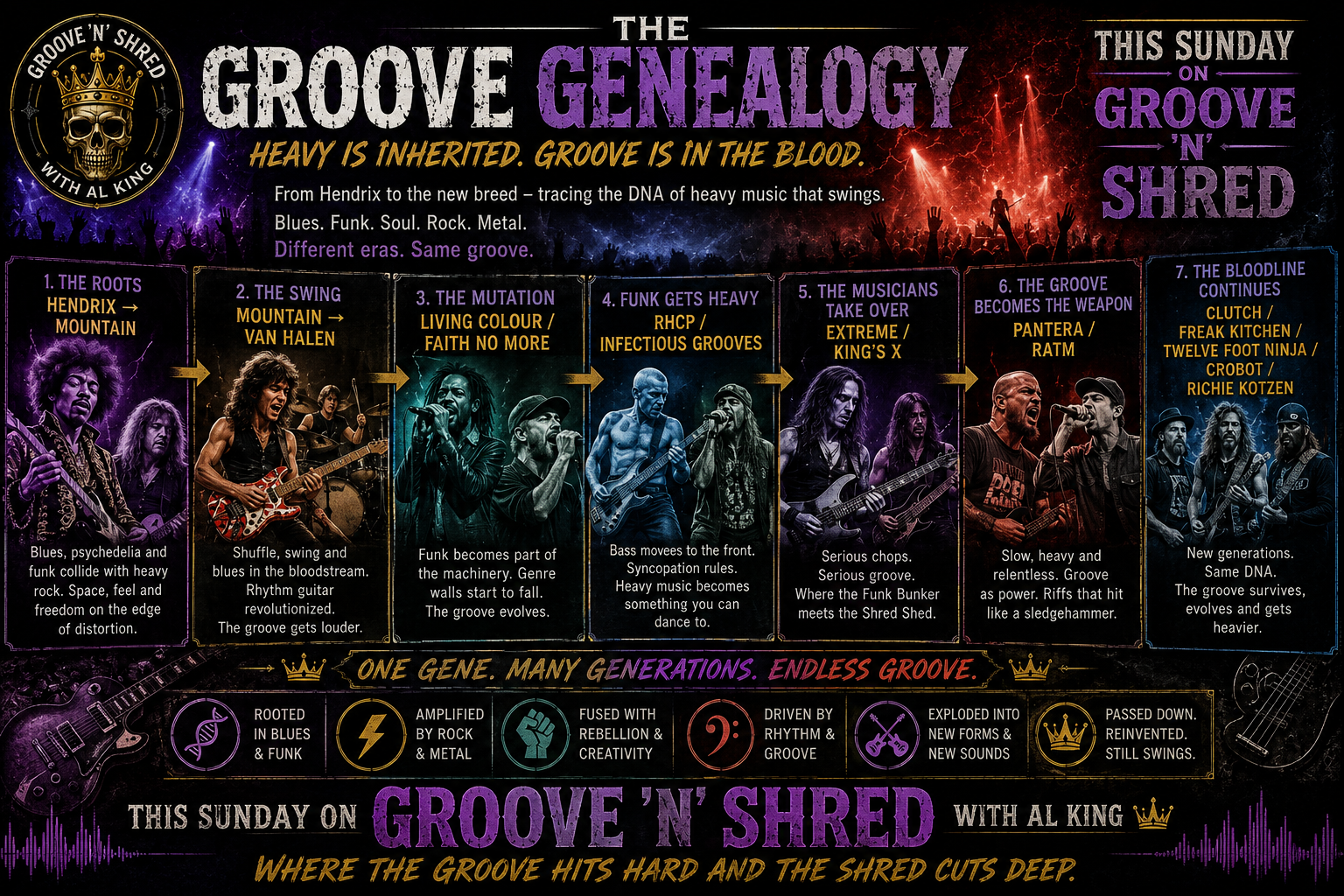
Heavy Is Inherited. Groove Is in the Blood.
Groove metal and funk metal didn’t suddenly appear in the late ’80s and early ’90s. The groove had been hiding inside heavy rock from almost the very beginning.
Our journey starts with Jimi Hendrix, where blues, psychedelia, soul and funk collided with the possibilities of the electric guitar. Hendrix understood something fundamental: heaviness isn’t just about volume or distortion. It’s about rhythm, space and feel.
Then came Mountain. Leslie West took that blues foundation and made it enormous. The riffs became denser, the amplification became heavier, but crucially, with Corky Laing behind the kit, the music could still swing.
And then Van Halen changed everything.
Eddie Van Halen is rightly remembered as one of history’s great lead guitar innovators, but perhaps just as important to the Groove ’n’ Shred story was his extraordinary rhythm playing. Eddie and Alex Van Halen understood swing. Underneath the pyrotechnics was blues, funk, shuffle and an almost elastic relationship with the beat.
By the end of the 1980s, that rhythmic DNA was mutating again.
With Living Colour and Faith No More, funk was no longer simply influencing heavy rock — it had become part of its machinery. The walls separating metal, funk, alternative rock and even hip-hop were beginning to collapse.
Then Red Hot Chili Peppers and Infectious Grooves pushed the rhythmic element even further. Bass moved to the front, syncopation became central and suddenly heavy music wasn’t merely something you headbanged to.
You could dance to it.
Meanwhile, Extreme and King’s X demonstrated that formidable musicianship didn’t have to come at the expense of feel. Nuno Bettencourt and Ty Tabor could deliver serious guitar fireworks while their bands maintained enormous rhythmic pockets. Here, the Funk Bunker and the Shred Shed effectively shared a wall.
Then something changed.
The groove became a weapon.
Pantera discovered that slowing down could actually make metal more powerful, while Rage Against the Machine fused enormous riffs with a rhythm section drawing just as much from funk and hip-hop as heavy metal.
Both arrived at essentially the same revelation:
You don’t have to play faster to sound heavier.
And the bloodline continues.
Clutch brought blues and swagger back into the equation. Freak Kitchen combined extraordinary musicianship with funk, metal and a distinctly warped sense of humour. Twelve Foot Ninja gleefully dismantled genre boundaries altogether, jumping between crushing metal, funk and everything in between. Crobot rediscovered the sweaty swagger of heavy ’70s rock and dragged it into the present.
And then there’s Richie Kotzen, who almost brings the entire family tree full circle: Hendrix-inspired soul and blues, virtuoso guitar technique, funk, hard rock and modern production all inhabiting the same musician.
So this isn’t simply a journey through genres. It’s a family tree.
From Hendrix to Mountain.
Mountain to Van Halen.
Van Halen to Living Colour and Faith No More.
Through RHCP and Infectious Grooves to Extreme and King’s X.
Into Pantera and Rage Against the Machine.
And onward through Clutch, Freak Kitchen, Twelve Foot Ninja, Crobot and Richie Kotzen.
More than fifty years of musical evolution connected by one stubborn gene:
the ability to be heavy as hell — and still swing.
The Groove Genealogy
Heavy is inherited. Groove is in the blood.
This Sunday on Groove ’n’ Shred with Al King – where the groove hits hard and the shred cuts deep.
0 Comments